
Music Visualizer App Overview
This article provides an in-depth exploration of the online platform Music Visualizer, a powerful web-based tool designed to convert audio files into captivating, dynamic visual effects. Throughout this comprehensive guide, we will examine the platform’s core capabilities, delve into the extensive customization settings available to creators, and discuss the practical applications of music visualization in the modern digital landscape. By detailing its user-friendly interface, broad format compatibility, and robust technical parameters, this piece serves as a complete manual for understanding how to leverage this application to transform standard audio tracks into engaging, unwatermarked multimedia experiences.
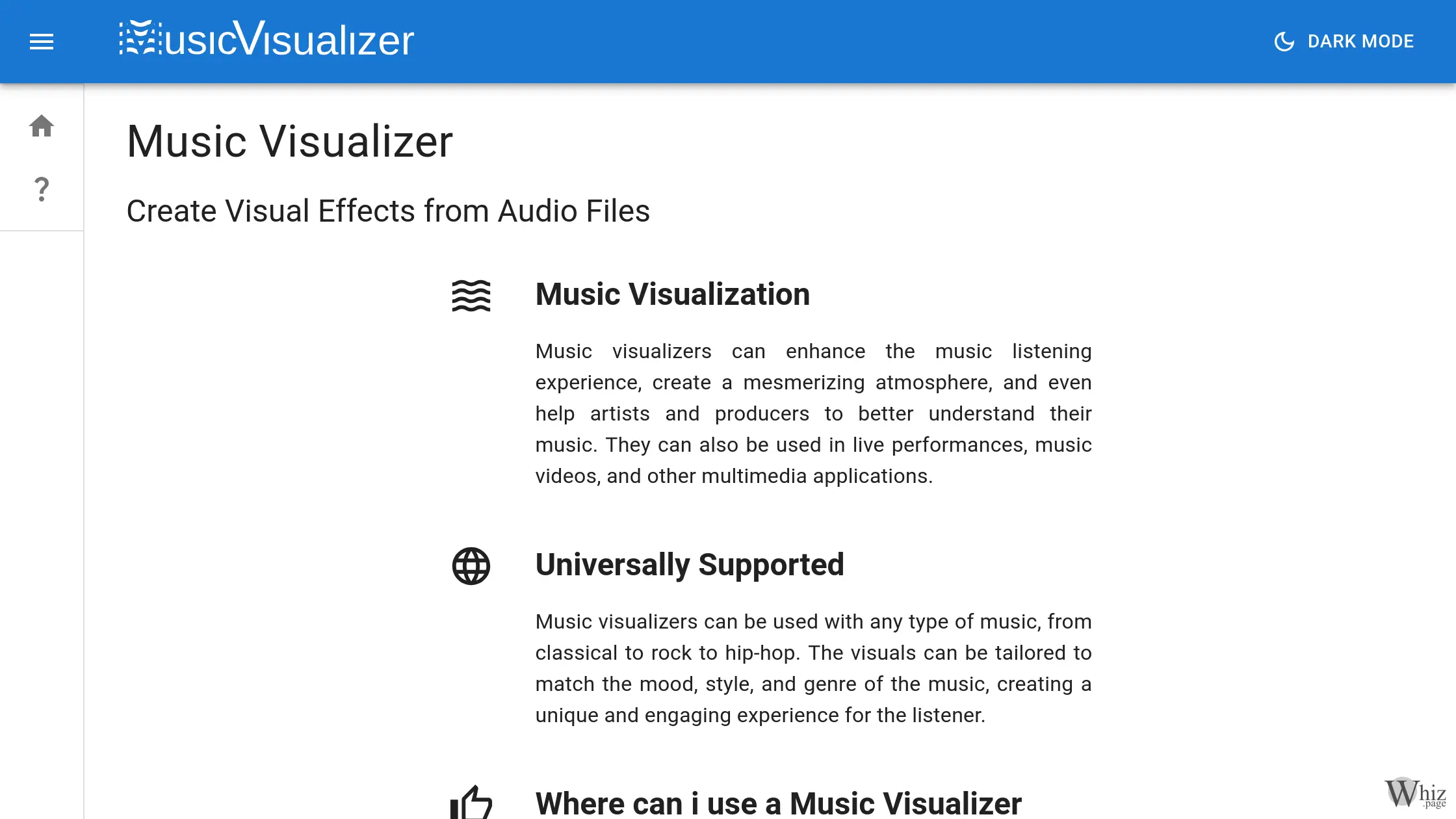
Music visualization is the process of generating animated imagery that renders in real-time or pre-rendered formats in direct response to the frequency, amplitude, and rhythm of an audio track. Historically, visualizers have been used to enhance the music listening experience, transforming an auditory event into a multi-sensory journey. This visual representation creates a mesmerizing atmosphere that can deeply engage an audience. For artists, music producers, and sound engineers, seeing the sonic landscape translated into waveforms can also provide a better understanding of their music’s dynamic range and stereo field. Whether transitioning from classical orchestral pieces to heavy rock, or from ambient electronic to rhythmic hip-hop, visualizers can be universally adapted. The imagery can be carefully tailored to match the specific mood, style, and genre of the music, creating a unique, branded, and highly engaging experience for the listener.
To access these capabilities without the need for expensive, heavy desktop software, creators can utilize the browser-based platform found at https://musicvisualizer.app. This website operates entirely in the cloud, allowing users to upload their audio streams and configure complex rendering parameters directly from their web browser. Because the heavy lifting of rendering is managed efficiently, users from any modern device—be it running Chrome, Firefox, Safari, Edge, or Opera—can create stunning visuals. The platform specializes in taking your audio, coupling it with personalized graphic settings, and outputting an MP4 video file that natively plays across virtually all devices and social media platforms.
One of the most impressive aspects of the platform is its deep level of customization, particularly within its waveform settings. Users are not restricted to generic, pre-set animations. Instead, they can manipulate the amplitude scale to dictate how dramatically the visualizer reacts to volume peaks. The “Draw” and “Mode” settings allow creators to set the specific visual filter modes, dictating the geometric shape and behavior of the moving audio waves. For complex stereo tracks, a “Split Streams” function is available, which separates the left and right audio channels into distinct visual elements on the screen. Colorization is equally robust; users can define “Wave Color A” and “Wave Color B” using a variety of color representation codes, including RGB, HEX, HSV, HSL, and CMYK. This ensures that a brand’s exact color palette can be matched flawlessly. Furthermore, the wave’s vertical position on the screen can be adjusted on a scale from 0 to 100, allowing space for logos or text.
Beyond the moving waveforms, the tool permits the inclusion of custom background images and videos. By uploading a background asset, creators can contextualize their audio—such as adding album art, artist photography, or looping atmospheric video clips behind the audio wave. The system automatically stretches the background to fit the designated video width and height, though users are advised to keep image sizes around 1920x1080 pixels to ensure smooth encoding without overwhelming the system’s FFmpeg encoder.
Speaking of encoding, the platform grants professional-level control over both video and audio output settings. In the Video Settings panel, users can dictate the exact width and height of the final MPEG-4 file, ensuring the dimensions are perfectly suited for their intended platform, whether that is a standard 16:9 YouTube video or a vertically oriented social media reel (keeping in mind dimensions must be divisible by two). A “Preset” option dictates the amount of CPU effort used during encoding; for instance, an “ultrafast” preset is highly recommended for social media uploads where file size is more critical than pristine archival quality. The Constant Rate Factor (CRF) can also be adjusted, where lower values yield better visual quality at the expense of a larger file size. On the audio side, the tool utilizes the high-quality Fraunhofer FDK AAC codec. Users have granular control over sample rates, bit rate controls (applied on a per-channel basis), and an adjustable cutoff frequency—a low pass filter process ranging from 173 Hz up to 20,000 Hz.
File compatibility is another major strength of the application. The
system supports an incredibly diverse array of audio and video file
extensions. Audio formats range from common MP3, WAV, and AAC files to
lossless formats like FLAC, ALAC (M4A), and OGG. It also accepts video
container formats such as MP4, MKV, AVI, MOV, and WEBM, allowing users
to extract the audio stream from an existing video to generate new
visuals. Users can even specify which audio stream to extract from a
multi-stream file using stream selection offsets (like
0:a). In terms of capacity, the platform is remarkably
generous, supporting file sizes up to a massive 2.15 GB. This allows for
the creation of very long videos, making it perfect for hour-long DJ
mixes, full album uploads, or lengthy podcast episodes.
The practical applications for the videos generated on this platform are virtually limitless. The output can be utilized for commercial purposes, including official music videos, promotional advertising, and social media marketing campaigns. DJs and live performers can project these visuals during stage shows to create an immersive environmental aesthetic. Additionally, they can be utilized in public or retail spaces to provide a dynamic visual accompaniment to background music. Furthermore, the platform integrates well with other digital tools. For example, users can render AI-generated text-to-speech audio files and subsequently run them through this visualizer to create engaging, kinetic typography or waveform videos for narration-heavy content.
Finally, one of the most appealing features for independent creators is the platform’s user-friendly licensing and lack of restrictions. All music visualization videos generated on the site are completely free to use in any commercial or personal capacity. The system does not apply any watermarks to the created video files—there are no forced visual logos overlaying your art, nor are there any audible imprints, tones, or spoken wordings embedded into the audio track. The content you create is entirely your own, requiring no mandatory attribution, though crediting the tool is always appreciated by the developers. This level of unhindered, high-quality, free production makes the application an invaluable resource for modern digital creators seeking to elevate their auditory content into the visual realm.